The G.I.D.E.O.N. Framework
The G.I.D.E.O.N. Framework is a practical model for intentional living, decision-making, and life navigation. Learn how to move from motion to aligned direction.
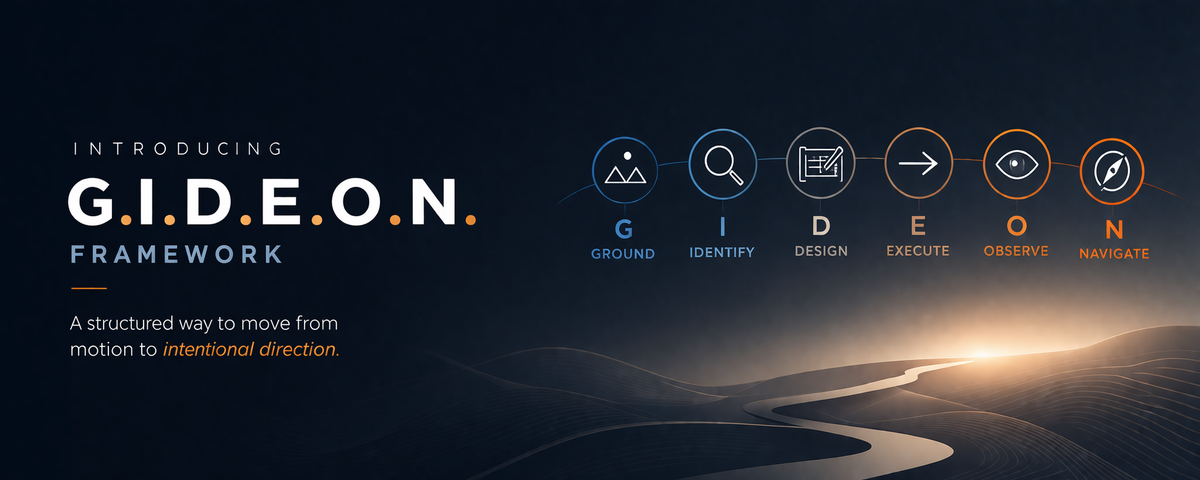
G.I.D.E.O.N. stands for:
Guided Intelligence for Direction, Execution, and Ongoing Navigation.
It is not a productivity system.
It is a disciplined way of thinking about life.
It exists to help thoughtful people move from reaction to intentional navigation.
Not once.
Repeatedly.
The Core Belief
Most misalignment does not require reinvention.
It requires recalibration.
Recalibration requires structure.
G.I.D.E.O.N. provides that structure.
Core Definition
The G.I.D.E.O.N. Framework is a structured, iterative model for navigating seasons of transition through intentional direction, disciplined execution, and ongoing recalibration.
Clarity unfolds through repeated cycles of reflection and aligned action.
The G.I.D.E.O.N. Cycle
Ground → Identify → Design → Execute → Observe → Navigate
You do not complete it.
You move through it — and return to it.
G — Ground
Stabilize awareness before action.
Focus:
- Name your current season.
- Clarify what feels misaligned.
- Separate reaction from reflection.
Questions:
- What season am I actually in?
- What feels misaligned?
- What feels steady?
- Where am I reacting instead of choosing?
- What has my body been trying to tell me?
This step interrupts autopilot.
Output:
A clear articulation of your current season.
I — Identify
Define the real decision.
Focus:
- Clarify the actual tension.
- Distinguish symptoms from root issues.
- Name what is truly at stake.
Questions:
- What is the real choice in front of me?
- Is this about pace, identity, boundaries, responsibility, or direction?
- What tradeoffs am I afraid to acknowledge?
- What have I been avoiding naming?
Clarity begins here.
Output:
A clearly defined Decision Statement.
D — Design
Create structure before movement.
Focus:
- Establish alignment criteria.
- Define constraints.
- Clarify non-negotiables.
Questions:
- What does alignment look like in this season?
- What are my constraints (financial, relational, emotional, spiritual)?
- What am I willing to trade?
- What is non-negotiable?
- What would future-me thank me for choosing?
Structure stabilizes emotion.
Output:
An Alignment Criteria & Constraints Map.
E — Execute
Move deliberately.
Focus:
- Take aligned action.
- Communicate clearly.
- Advance without overcorrection.
Questions:
- What is the next aligned step?
- What conversation needs to happen?
- What boundary needs to be set?
- What first action signals commitment?
Execution builds momentum.
Output:
An Intentional First Move.
O — Observe
Assess reality without ego.
Focus:
- Evaluate signals objectively.
- Separate data from fear.
- Notice emotional and practical shifts.
Questions:
- What signals are emerging?
- What feels lighter?
- What still feels heavy?
- What did I misjudge?
- What surprised me?
Observation strengthens discernment.
Output:
A Signal-Based Assessment.
N — Navigate
Recalibrate and continue.
Focus:
- Refine direction.
- Adjust pace or boundaries.
- Recommit with clarity.
Questions:
- What needs to adjust?
- Is the direction right but the pace wrong?
- Is the structure sound but the boundary weak?
- What now becomes clear?
Navigation is not reinvention.
It is refinement.
Output:
A Refined Direction Statement — and re-entry into Ground.
What Makes This Different
This framework does not chase speed.
It builds steadiness.
It does not demand reinvention.
It supports integration.
It does not eliminate uncertainty.
It builds self-trust.
Who It’s For
Thoughtful adults navigating:
• Career transitions
• Responsibility overload
• Identity recalibration
• Mid-career realignment
• Creative or spiritual shifts
It is structured enough for professionals.
Flexible enough for anyone.